 EN
 LT
 RU


Wisdom tooth pain can be caused by the tooth erupting, gum inflammation around a partially erupted tooth, tooth decay, or infection. It is not possible to determine the cause based solely on the location or intensity of the pain. If the pain persists, recurs, or becomes worse, you should see a dentist. Not every painful wisdom tooth needs to be removed.
Contents
- When to seek immediate care for wisdom tooth pain
- Help while waiting for your appointment
- Why a wisdom tooth might hurt
- How to recognize a possible wisdom tooth problem
- How the cause of pain is determined
- When a wisdom tooth can be monitored
- What problems can an untreated condition cause
- When a wisdom tooth may need to be removed
- How wisdom tooth extraction is performed and what to expect afterward
- Frequently Asked Questions
- Consultation for wisdom tooth pain in Vilnius
When to seek immediate care for wisdom tooth pain
Do not delay seeing a dentist if the pain is severe, interferes with sleeping or eating, swelling of the cheek or jaw is increasing, you have a fever, notice an unpleasant taste in your mouth, or find it increasingly difficult to open your mouth. In such cases, seek dental care the same day.
If you have difficulty breathing, swallowing, or speaking, or if your neck or the area around your eye is swelling, you need immediate medical attention. Go to an emergency department; if you are having difficulty breathing or there is another life-threatening emergency, call 112. Do not wait for a scheduled dental appointment.
Help while waiting for your appointment
Temporary measures may help relieve discomfort, but they do not treat the underlying cause of the pain. While waiting for your dental examination:
- Gently brush your teeth with a soft-bristled toothbrush. Do not try to puncture the swelling, squeeze an abscess, or “expose” the tooth yourself.
- Choose soft foods and try not to chew on the painful side. Avoid anything that makes the pain worse, such as very hot or very cold foods.
- If suitable for you, take pain-relieving medication according to the instructions in the package leaflet. Ask a pharmacist for advice if necessary, especially if you take other medicines, are pregnant, or have chronic health conditions.
- Adults may gently rinse their mouth with warm salt water and spit it out. This advice does not apply during the first 24 hours after a tooth extraction – in that case, follow the instructions provided by the dentist who performed the procedure.
If the toothache lasts for more than two days, see a dentist even if pain medication is helping. If you experience severe pain or any of the warning signs mentioned above, do not wait this long.
Why a wisdom tooth might hurt
As a wisdom tooth erupts, you may experience pressure, sensitivity, or an aching sensation. However, prolonged or recurring pain should not automatically be considered a normal part of tooth eruption.
When a tooth erupts only partially, a flap of gum tissue may remain over it. Food debris and bacteria can accumulate beneath this flap, potentially causing inflammation of the tissues around the tooth – a condition known as pericoronitis.
Other possible causes of pain include:
- tooth decay affecting the wisdom tooth or the adjacent second molar, and complications resulting from it;
- inflammation of the gums or other tissues surrounding the tooth;
- infection or an abscess;
- less commonly, cystic or other pathological changes developing around an unerupted tooth.
An irregular or horizontal tooth position may make eruption and cleaning more difficult, but this alone does not prove that the wisdom tooth is the source of the pain.
How to recognize a possible wisdom tooth problem
Pain is usually felt at the very back of the dental arch. It may be accompanied by red or swollen gums, pain when chewing, or an unpleasant taste in the mouth. When inflammation is present, it may also become more difficult to open the mouth fully, and the pain may spread across a wider area of the jaw.
Similar symptoms can also be caused by problems affecting an adjacent tooth or the gums. For this reason, an accurate diagnosis is made during a dental examination and, when necessary, with the help of an X-ray.
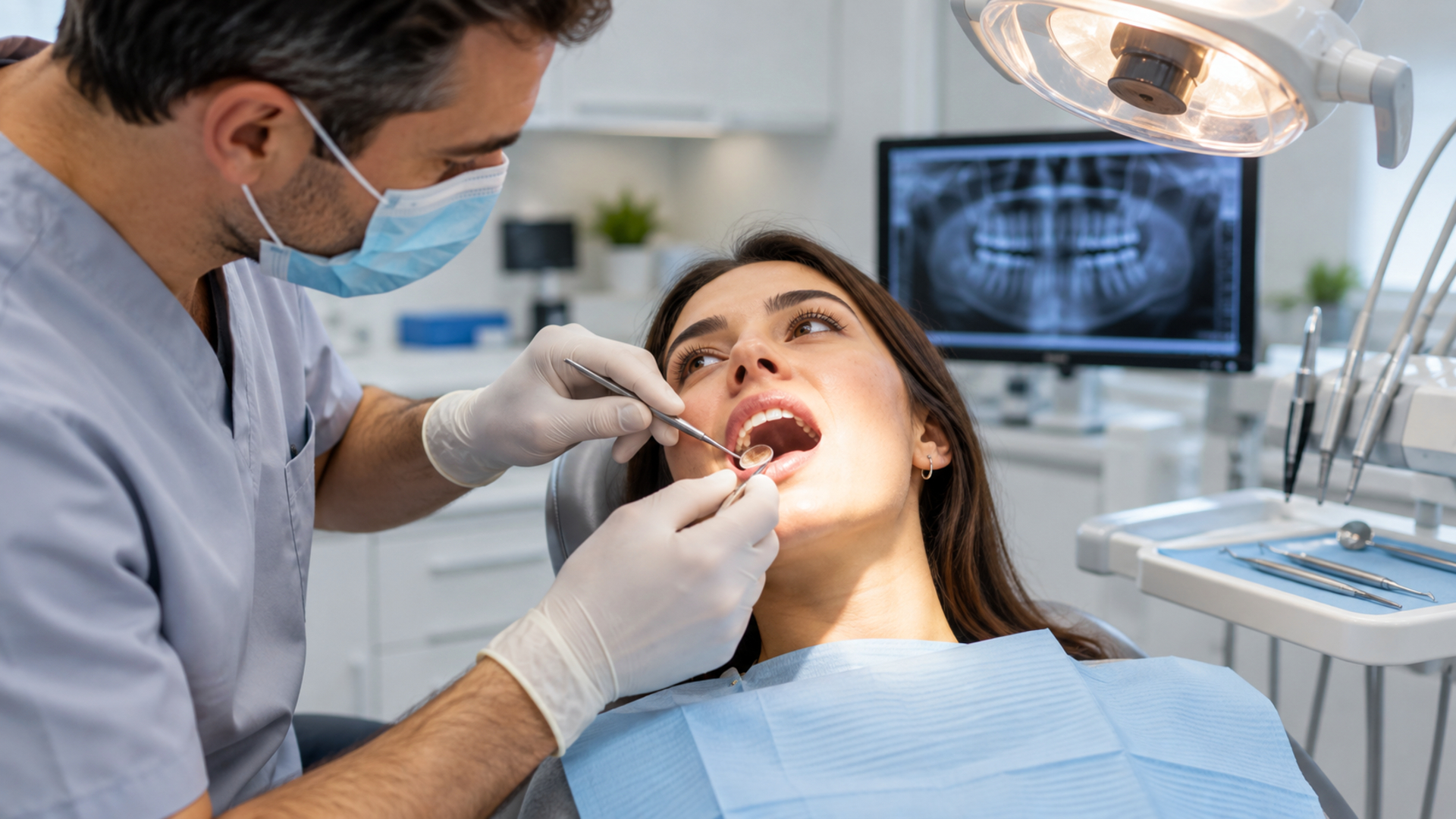
Note: This image is for illustrative purposes only. It does not depict actual clinic patients, staff, or a specific treatment situation.
How the cause of pain is determined
During the consultation, the dentist will ask when the pain began, whether it recurs, and whether you have experienced swelling, fever, or other symptoms. Tell the dentist about any medications you are taking, allergies, and relevant medical conditions.
During the oral examination, the dentist assesses the condition of the wisdom tooth and adjacent teeth, the gum flap, oral hygiene, and any signs of tooth decay or infection. An X-ray may be taken when necessary to assess the tooth’s position, root anatomy, and relationship with surrounding structures.
A three-dimensional cone-beam computed tomography (CBCT) scan is not necessary for every patient. The dentist may recommend it when standard X-rays do not provide enough information to answer a specific diagnostic or treatment-planning question.

Note: This image is for illustrative purposes only. It does not depict actual clinic patients, staff, or a specific treatment situation.
When a wisdom tooth can be monitored
Not every wisdom tooth needs to be removed. If no disease or other indication for extraction is found, the dentist may recommend monitoring the tooth and attending regular checkups. Important considerations include whether the tooth can be cleaned properly and whether it is causing damage to the adjacent tooth. The need for additional examinations is determined individually.
Monitoring does not mean ignoring recurring pain. If new symptoms appear or the condition worsens, another dental examination is necessary.
What problems can an untreated condition cause
Untreated inflammation may recur or spread, while tooth decay may damage the wisdom tooth or the adjacent tooth. Possible complications include damage to the tissues surrounding the tooth, an abscess, and, less commonly, cystic changes. These complications do not occur in everyone who has wisdom teeth, but it is important to identify the cause of recurring symptoms.
When a wisdom tooth may need to be removed
Extraction may be recommended in cases of recurrent pericoronitis, a tooth that has been irreparably damaged by decay, damage to an adjacent tooth, or other identified pathological changes. Pain alone, or simply having an unerupted wisdom tooth, is not sufficient reason to decide on surgery without a professional assessment.
When making the decision, the dentist considers the position of the tooth and its root anatomy, previous episodes of inflammation, whether the tooth can be treated and maintained, the patient’s general health, and the benefits and risks of extraction. In the lower jaw, the relationship between the roots and the nerve canal is particularly important.
How wisdom tooth extraction is performed and what to expect afterward
Wisdom tooth extraction is a surgical procedure, although the complexity of the procedure varies. A fully erupted tooth may be relatively straightforward to remove, whereas an unerupted or improperly positioned tooth may require an incision in the gum, removal of a small amount of bone, or sectioning of the tooth.
Local anesthesia is most commonly used. You may feel pressure during the procedure, but if you experience sharp pain, tell your dentist immediately. Your individual risk of complications will also be discussed before the procedure.
After extraction, pain, swelling, and limited mouth opening may occur. Follow your dentist’s instructions regarding wound care, diet, medication, and physical activity. During the first 24 hours, avoid vigorous rinsing and do not disturb the wound, as this may dislodge the blood clot that is important for healing.
If the pain or swelling becomes worse, you develop a fever, notice an unpleasant taste, or the bleeding does not stop, contact your dentist. Difficulty breathing or swallowing requires immediate medical attention.
Learn more about the wisdom tooth extraction procedure
Frequently Asked Questions
Can a wisdom tooth hurt while it is erupting?
Mild, short-term sensitivity may occur. However, severe, prolonged, or recurring pain – especially when accompanied by swelling or fever – should be assessed by a dentist.
How long can wisdom tooth pain last?
There is no single duration that applies to everyone, as it depends on the cause. If the pain lasts for more than two days, see a dentist. Severe pain, swelling, or worsening general health are reasons to seek help sooner.
Does wisdom tooth pain always mean the tooth needs to be removed?
No. In some cases, the inflammation or the tooth itself can be treated, while in other cases extraction may be the most appropriate option. The decision depends on the diagnosis, the position of the tooth, whether it can be preserved, and the condition of the surrounding tissues.
Does wisdom tooth inflammation always require antibiotics?
No. Pericoronitis is primarily managed with local treatment measures, such as cleaning the inflamed area. Antibiotics may be required if the infection spreads, if systemic symptoms such as fever develop, or if local treatment is not sufficient. Antibiotics are prescribed by a doctor and, on their own, do not eliminate every possible cause of inflammation.
Does the problem disappear once the pain goes away?
Not necessarily. Symptoms of inflammation may temporarily improve and then return. If the pain has recurred, or if you have experienced swelling or other signs of inflammation, arrange a dental examination even if you are currently feeling better.
Can I wait for a wisdom tooth to fully erupt?
Monitoring may be appropriate when a dentist has assessed the situation and sees no reason for treatment. Recurring pain, swelling, or difficulty opening your mouth are not symptoms that should be ignored while waiting for the tooth to erupt.
Consultation for wisdom tooth pain in Vilnius
If you are experiencing pain in the wisdom tooth area or recurring inflammation, schedule a consultation with a dentist at “Simetria Dentica.” An examination will help determine the cause of your symptoms and identify the most appropriate treatment.
To schedule an appointment: +370 635 33335 or info@simetriadentica.lt.
Address: Nemenčinės pl. 4E, Vilnius, Antakalnis.
This article is intended for general information purposes only and does not replace an individual consultation with a dentist.